

Abstract
Most skincare advice is written for a climate Queensland doesn't have. The research behind a lot of standard routines comes out of temperate Europe and the northern United States, where the dominant skin stressor is dryness and the dominant fix is a heavier moisturiser. Queensland's problem isn't a lack of moisture in the air. It's UV intensity, humidity, and the constant switch between the two, outdoors and air-conditioned indoors, often several times in a single day.
Treating that as a simple hydration problem misses what's actually happening to the skin barrier.
Three Stressors, Not One
UV exposure is the best-documented of the three. A randomised trial run out of Nambour, Queensland, and published in 2013 in the Annals of Internal Medicine, followed 903 residents for four and a half years and found that daily sunscreen use reduced visible photoageing by roughly 24% compared with discretionary use. It remains one of the only long-term randomised trials anywhere in the world testing sunscreen against ageing outcomes rather than burn prevention, and it was run on exactly this population.
Humidity works differently from the way most people assume. High ambient humidity can slow surface water evaporation, which sounds like a benefit, but it also means sweat sits on the skin for longer and the barrier spends more time in a semi-occluded, warm, damp state. That environment is harder on the skin's microbiome and lipid structure than a simple dry-air model accounts for, which is part of why skin can feel both oily and compromised at the same time in a Queensland summer, not one or the other.
Air conditioning turns the humidity problem into a swing rather than a steady state. Moving between humid outdoor air and a cold, dry, air-conditioned interior, repeatedly, through a single day, asks the barrier to re-adjust its water-loss rate on a schedule most skin never gets outside this climate. Dr Alison Jamieson has observed this pattern across four decades of Queensland practice: patients who live and work in air-conditioned environments but spend real time outdoors show barrier symptoms that don't fit neatly into either a "dry climate" or "humid climate" treatment model, because they're living in both within hours of each other.
Why the Protocol Splits Into AM and PM
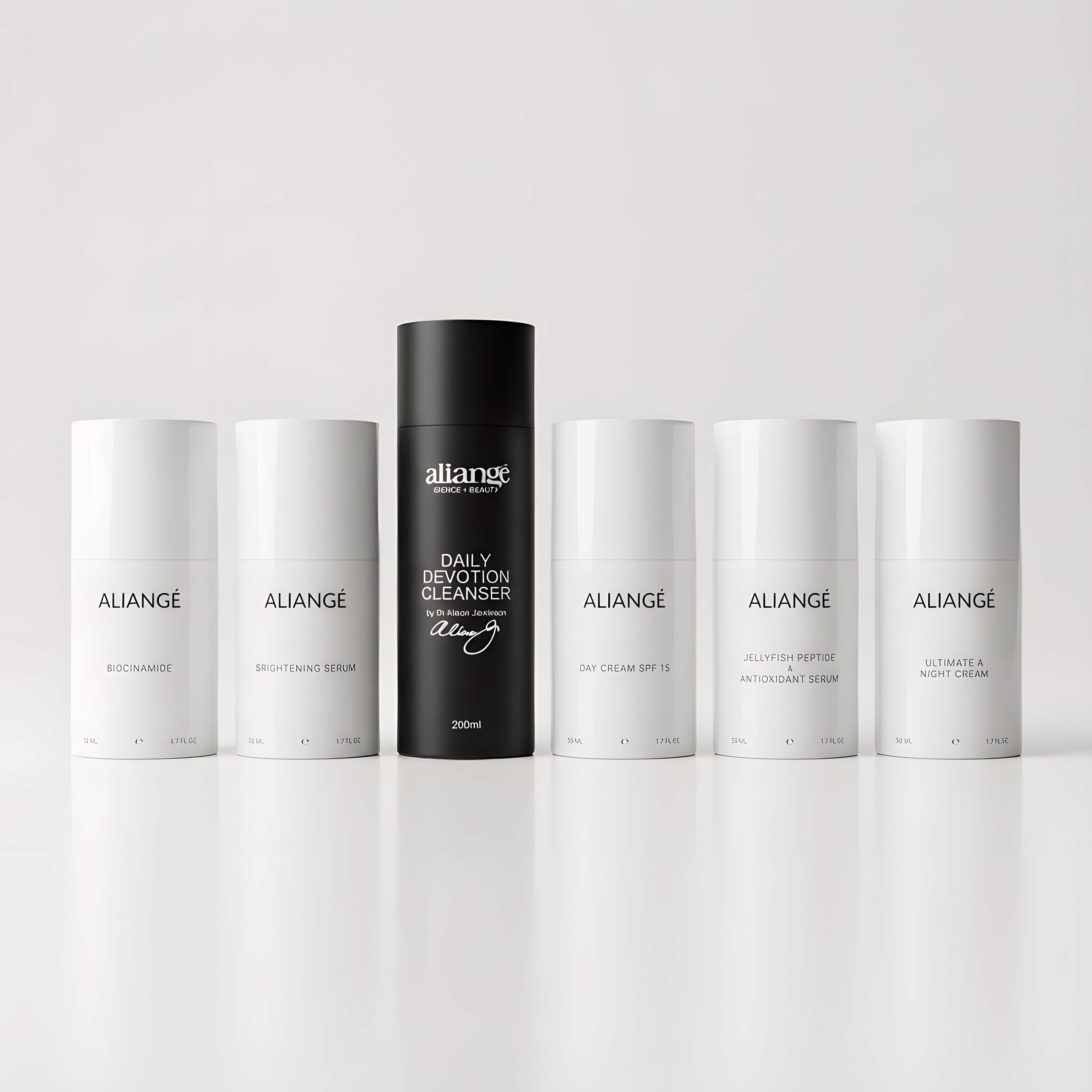
This is the reasoning behind Aliangé's core structural decision, not a stylistic one. The AM Protocol exists to protect and defend: barrier support, antioxidant defence, and SPF, before the day's UV and humidity exposure begins. The PM Protocol exists to correct and renew: the actives that need skin at rest, overnight, away from UV, to do their work without raising photosensitivity.
In practice, that means:
Cleanse without adding to the barrier problem. Sodium Lauryl Sulfate, the surfactant most cleansers are built on, has been shown to increase transepidermal water loss by 37% and reduce ceramide content by 22% within three days of use. In a climate already asking more of the barrier, a cleanser that compounds the problem twice a day is a measurable cost, not a neutral step. The Daily Devotion Cleanser is formulated on Sodium Cocoyl Isethionate instead, for exactly this reason.
Support the barrier before UV exposure, not after. The Biocinamide Serum carries a Lactococcus Ferment Lysate shown in trial work to reduce transepidermal water loss by around 18% and support filaggrin production, the protein scaffold that holds the barrier's water-retention structure together. That matters more in a climate putting the barrier through repeated humidity swings than it would somewhere the air stays one way all day.
Treat SPF as non-negotiable, not seasonal. Queensland's UV index runs high for most of the year, including on overcast days, which is part of what the Nambour Trial's daily-use cohort actually did differently from the discretionary-use group. Day Cream SPF 15 is formulated to sit as the final AM step precisely so the barrier-support work done by the steps before it isn't undone within hours of walking outside.
Together, these three steps make up the AM Protocol: cleanse, serum, SPF, built around what this specific climate does to skin rather than a generic morning routine borrowed from a different one.
Common Questions
Does living somewhere humid mean I need less moisturiser?
Not necessarily. Humidity can slow water evaporation from the skin's surface, but it doesn't protect the barrier itself, and air conditioning reverses the effect within minutes of walking indoors. The relevant question isn't how much moisture is in the air, it's how stable your barrier is against the swing between environments.
Why does my skin feel oily outdoors but tight indoors in the same day?
This is consistent with the humidity-swing pattern described above rather than two separate skin conditions. Sebum production and barrier water-loss respond to different triggers, and Queensland's climate can activate both within hours of each other. It's a reason to support the barrier consistently rather than switching products based on how skin feels at a given moment.
Is SPF still necessary on a cloudy or rainy day?
Yes. Queensland's UV index frequently stays in the moderate-to-high range through cloud cover, and the Nambour Trial's daily-use group applied sunscreen regardless of visible sun, which is a meaningful part of why that group showed less photoageing over the study's four and a half years.
The Climate Decides the Design
None of this is about Queensland being a harsher place to have skin, in the sense of needing more products. It's about the fact that a protocol built for a stable, dry, temperate climate was never going to answer what happens here. The AM Protocol and PM Protocol are designed around defend-by-day, repair-by-night for a reason specific to where most Aliangé customers actually live: a climate that asks the skin to do more, and asks it on a schedule most skincare science was never written to account for.
Leave a comment
This site is protected by hCaptcha and the hCaptcha Privacy Policy and Terms of Service apply.